8086 Program For Check Status Of Flag Register Using Pushf And Pop
- 8086 Assembly Language Programs Examples
- 8086 Program For Check Status Of Flag Register Using Pushf And Popcorn
- 8086 Program For Check Status Of Flag Register Using Pushf And Popular
I made a simple assembly program to count the number of ones in a register. Since this is basically my first ever, I would like to hear what I can improve or if there are some major flaws in this o. Flag manipulation instruction of 8086:-Flag Instructions (Flag Transfer): These instructions are related to movement of flag register to/from a register and memory. Flag Instructions (Flag transfer): LAHF (Load AH register from flags) SAHF (Store AH register flags) PUSHF (Push flags onto stack) POPF (Pop flags off stack).
FLAGSREGISTER='h2headingh3'style='color:rgb(0,0,0);'name='flags_register'>
Flags Register - determines the current state of theprocessor. They are modified automatically by CPU aftermathematical operations and allow one to determine the type of theresult as well as determine conditions to transfer control to otherparts of the program.Generally you cannot access these registers directly.
- Carry Flag (CF) - this flag is set to 1 whenthere is an unsigned overflow. For example when you addbytes 255 + 1 (result is not in range 0..255). When thereis no overflow this flag is set to 0.
- Parity Flag (PF) - this flag is set to 1 whenthere is even number of one bits in result, and to 0 whenthere is odd number of one bits.
- Auxiliary Flag (AF) - set to 1 when there is anunsigned overflow for low nibble (4 bits).
- Zero Flag (ZF) - set to 1 when result iszero. For non-zero result this flag is set to 0.
- Sign Flag (SF) - set to 1 when result isnegative. When result is positive it is set to0. (This flag takes the value of the most significantbit.)
- Trap Flag (TF) - Used for on-chip debugging.
- Interrupt enable Flag (IF) - when this flag is set to1 CPU reacts to interrupts from external devices.
- Direction Flag (DF) - this flag is used by someinstructions to process data chains, when this flag is set to0 - the processing is done forward, when this flag is set to1 the processing is done backward.
- Overflow Flag (OF) - set to 1 when there is asigned overflow. For example, when you add bytes 100 +50 (result is not in range -128..127).
What is flag register of 8086?
The FLAG register is the status register in the Intel 8086 microprocessor that contains the current state of the microprocessor.This register is 16 bits wide.
What is the size of flag register?
What does do flag register in 8086?
How many 16 bit flag registers in 8086?
There is one 16 bit flag register in the 8086/8088.
Which are the registers present in 8086?
General Purpose Register, Index Register, Pointer Register, Flag Register, Segment Register.
What is psw of 8086?
Flag Register (PSW) Status is indicated with individual bits: 0 - CF - Carry Flag 2 - PF - Parity Flag 4 - AF - Auxiliary carry Flag 6 - ZF - Zero Flag 7 - SF - Sign Flag 8 - TF - Trap Flag 9 - IF - Interrupt Flag 10 - DF - Direcetion Flag 11 - OF - Overflow Flag
What happens when branch instruction comes in 8086?
When a branch (or 'jump') instruction is executed, the condition codes bits (in the flag register) determine whether or not the Program Counter (PC register) is changed to the Effective Address specified by the instruction; if not, then the PC is unchanged.
What are the different microprocessor registers?
Register M is used to refer to the contents of the memory address stored in the HL register pair in Indirect Addressing mode. SP- Stack Pointer PC- Program Counter Flag Register 8086:- Data Registers:- AX = AH+AL AL is the accumulator in 8086 in an 8 bit operation and in 16 bit operations AX is used BX,CX,DX Segment Registers:- ES-Extra Segment Register DS-Data Segment Register SS-Stack Segment Register CS-Code Segment Register SP-Stack Pointer IP-Instruction Pointer… Read More
How you can change value of flag register of 8086?
In general, the best way to change the flag register is to perform some operation that sets or clears flags. If you are careful, you can also push the flags onto the stack, manipulate the stored value, and then pop them back off. This is often the method used by a debugger to set the single step flag. When using this method, it is important to not set an inconsistent combination of flags.
What is meant by flag register and what is flag?
Flag register : specific to the x86 architecture. Flag : Mark (an item) for attention or treatment in a specified way.
How many flag registers are there in 8086?
There are altogether 9 flag registers available and the are : carry flag,parity flag, auxillary flag,zero ,sign,trap,interrupt,direction,overflow flag.
When does the overflow flag in 8086 set?
In the 8086/8088, the overflow flag is set when the result of an arithmetic instruction exceeds the bounds of the signed representation of a number. This is not the same as the carry flag, which is used for the unsigned representation. Both flags get set as needed. You decide which one to pay attention to.
Draw the functional block diagram of 8086 microprocessor and explain?
8086 has two blocks Bus Interfacing Unit(BIU) and Execution Unit(EU). The BIU performs all bus operations such as instruction fetching, reading and writing operands for memory and calculating the addresses of the memory operands. The instruction bytes are transferred to the instruction queue. EU executes instructions from the instruction system byte queue. Both units operate asynchronously to give the 8086 an overlapping instruction fetch and execution mechanism which is called as Pipelining. This results in… Read More
What is flag register of 8085?
The flag register is in an 8085 microprocessor. It is an 8-bit register which contains 5 bit positions. These flags are known as zero, sign, carry, parity and auxiliary carry.
What is psw in 8086 microprocessor?
the flag registers of 8086. 16-bits psw. 9bits are active. the rest are don't care. OF(11)-overflow flag DF(10)-direction flag IF(9)-interrupt enable flag TF(8)-trap flag SF(7)-sign flag ZF(6)-zero flag AF(4)-auxillary carry flag PF(2)-pariry flag CF(0)-carry flag 6bits/flags are conditional flags- OF, SF, ZF, AF, PF, CF 3 are control flags- DF, IF, TF
Function of flag register?
The main function of flag register is show the status of result stored in accumulator after execution of an instruction. Amar oli Dang,Nepal
The carry flag bit is not modified by which arithmetic operation in 8086?
Which are the basic parts of 8086?
general purpose registers,segment registers,pointers and index registers,flag registers
Flag registers in Pentium 2 microprpcessor?
list 8-bit register that are used for register addressing
What are the functions of execution unit in 8086 Intel?
Basically the function of execution unit in 8086 is to perform all arithmetic and logic operations.It tells the Bus Interface unit(BIU) where to fetch instructions and data from.It has 4 components:Control circuitry,ALU,Flag registers and general purpose registers. 1.control circuits-it directs all the internal operations. 2.ALU-performs all logic operations. 3.general purpose registers-used to store data during execution. 4.flag registers-it has a 16bit flag register containing 9 flags that are set for certain conditions during any operation.Ex.carry… Read More
What is the use of debug in 8086 microprocessor?
The debug flag in the 8086/8088 microprocessor causes one instruction to be executed, followed immediately by a debug interrupt. The flag then gets turned off, so you get get nested debug interrupts. This is used by a debugger program to single step a process that it is debugging (the debugee, so to speak).
What is the use of direction flag and Trace flag in 8086?
The direction flag (DF) controls the direction of repeated string instructions. The trap flag (TF) executes one instruction and then executes a debug (INT 1) instruction so that a debugger can single step through a program.
How many flags are there in the flag register of 8085?
There is only one flag register which is of 8 bits. But only five bits are necessary to tell the status of the result i.e. these five bits can be used as five flags. (One bit = one flag). D7=Sign Bit (0= positive, 1= negative) D6= Zero Flag D4= Auxiliary Carry Flag D2 = Parity Flag D0= Carry Flag
What are the release dates for Waving American Flag - National Cash Register Co- - 1904?
Waving American Flag - National Cash Register Co- - 1904 was released on: USA: March 1904
What are the release dates for Girl Waving American Flag National Cash Register Co- - 1904?
Girl Waving American Flag National Cash Register Co- - 1904 was released on: USA: January 1904
What are the registers available in 8085 microprocessor?
1.General purpose register 2.Temporary register a)Temporary data register b)W and Z registers 3.Special Purpose register a)Accumulator b)Flag register c)Instruction register 4.Sixteen bit register a)Program counter b)stack pointer
Conditional results after execution of an instruction in a microprocess is stored in?
What is CLD in 8086?
Clear Direction flag. SI and DI will be incremented by chain instructions: CMPSB, CMPSW, LODSB, LODSW, MOVSB, MOVSW, STOSB, STOSW.
What type of flags in 8086 and 8088 microprocessor and their uses.?
There are nine flags in the 8086/8088. SF - Sign Flag - The result is negative ZF - Zero Flag - The result is zero AF - Auxillary Carry Flag - A BCD carry occurred PF - Parity Flag - Indicates the oddness or evenness of the number of bits CF - Carry Flag - An unsigned carry occurred OF - Overflow Flag - A signed overflow/carry occurred DF - Direction Flag - Controls the… Read More
The different types of FLAGS register?
There are a huge number of different FLAG registers. The most common are zero flag (Z), carry flag (C), sign flag/ negative flag (S/N), and overflow flag (V/O/W). Each flag contains different information about the state of the processor.
How many stripes are on the first flag?
Here is a site that will explain the various styles the flag has been designed. http://www.usa-flag-site.org/history.shtml
How many flag registers are there in 8085?
We have only one flag register of 8 bits. Bits description is as follows (Assuming D0=LSB & D7=MSB) D7=Sign Bit. D6= Zero Flag D4= Auxiliary Carry Flag D2 = Parity Flag D0= Carry Flag.
What do the colors on the Sweden flag represent?
Here is a link that should explain exactly what the colors of the Sweden flag represent.
Should students be allowed to display the Confederate flag in school explain why or why not?
The short answer: The confederate flag is considered to be racist.
What is a flag in micro processor?
Flags are kind of register that record the condition of a microprocessor's calculation process.
Difference between 8085 and 8086?
Differentiate Between 8085 and 8086 Solution: SN 8085 8086 1 It is a 8-bit micro processor It is a 16-bit processor 2 It contains 16-bit address bus and 8-bit data bus It contains 20-bit address bus and 16-bit data bus. 3 It doesn't have memory segmentation feature 8086 has a special concept called as memory segmentation. It allows parallel processing 4 There is no overflow flag 8086 their exists a overflow flag along with condition… Read More
Which bit of flag register is used for controlling the si and di?
The direction flag (DF) is used to control the use and direction of repeated string operations involving DI and SI.
Flag of Japan explain?
The national flag of Japan, commonly called the Hinomaru, consists of a white sheet with a red disk in the center.
Pink flag over the blue temple explain the meaning of this topic?
In an american flag approximately what part of the flag is blue Explain?
On the American flag, the upper left hand corner is referred to as the field and that is the part of the flag that is blue. The white stars are present on top of the blue field on the flag. The blue field takes up 17.6% of the entire flag.
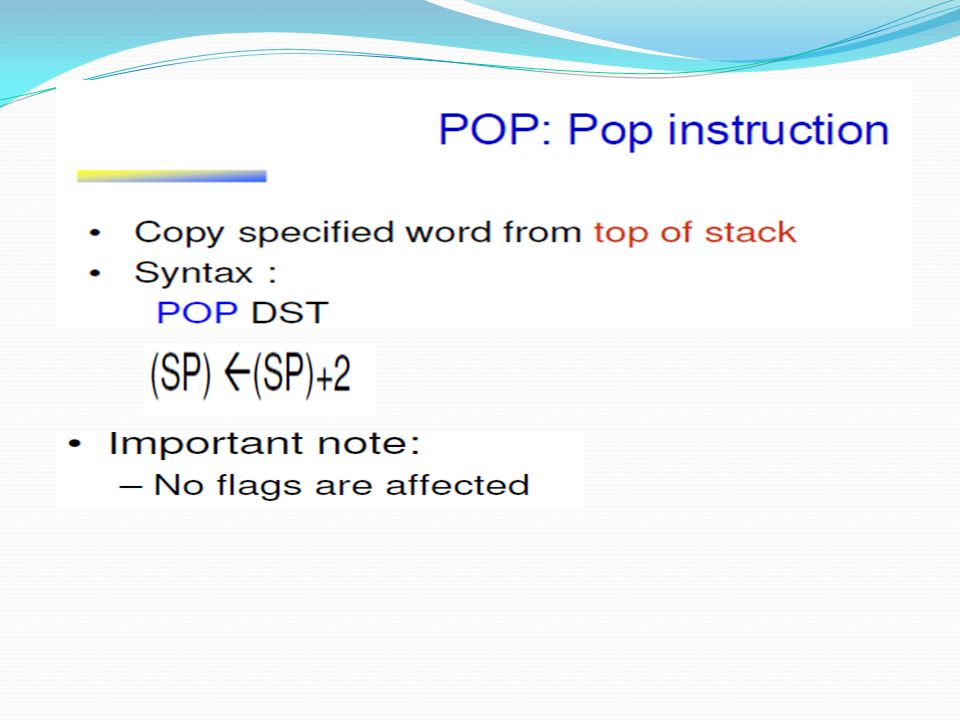
Give the steps to set trap flag to 1?
;assuming trap flag is the 8th bit in the flags register pushf pop ax or ax,0100h push,ax popf
What is the US State of Alaska's State song?
The name of Alaska's state song is 'Alaska's Flag'. The lyrics explain the symbolism of the Alaskan flag.
PowToon is a free tool that allows you to develop cool animated clips and animated presentations for your website, office meeting, sales pitch, nonprofit fundraiser, product launch, video resume, or anything else you could use an animated explainer video. Estudio descriptivo. Created using PowToon - Free sign up at - Create animated videos and animated presentations for free.
Which instruction is used to clear accumulator if content is already there in that accumulator?
To clear only Accumulator & not the Flag Register, you can use: 1) ANI 00 H 2) MVI A, 00 H To clear both Accumulator as well as Flag Register, use: LXI H, 0000 H PUSH H POP A.
Explain the love-hate relationship between Jack and Ralph?
Explain what the 3 colors of the US flag came to represent?
Carry flag and over flow flag in 8051?
Carry flag is the the bit 7 of the 8 bit PSW register, whenever there is an addition or subtraction process that has a carry on its 7th bit, the carry flag (C/CY) will be set to 1. OV is set to 1 when there is an arithmetic overflow. this applies to signed and unsigned operations.
Explain the evolution of Indian flag over a period of time?
The first flag was hoisted in 1906. In 1907, the second form of the flag was hosted. In 1917, another version was hoisted in Paris. A youngster presented another version to Mahatma in 1921Êand it was adopted as the flag. In 1931, the tricolor was adopted as the national flag. The final version of the flag, which had a spinning wheel was adopted in 1947
Why flags are used in 8086 processors?
Flags are used in CPUs to return the status of mathematical computations. They are used so conditional operations will work. Flags will set under conditions such as a result being negative, the result being zero, a comparison being equal, whether there is an overflow (number too big for the register), and whether there is a mathematical carry operation. Here is an example of how flags are used in Assembly: Cmp AX, 0 ;Is it zero… Read More
What fraction of the American flag is blue explain?
The standard proportion of the entire flag is 1 x 1.9 The standard proportion of the blue field is 0.5385 x 0.76 0.40926 ÷ 1.9 = 0.2154 which means that 21.54% of the flag is blue. That's 1077/5000
What part of the American flag blue explain?
one fifth because if you divide it equally in fifth, i lookes well
For the sake of curiosity I'm trying to read the flag register and print it out in a nice way.
I've tried reading it using gcc's asm keyword, but i can't get it to work. Any hints how to do it? I'm running a Intel Core 2 Duo and Mac OS X. The following code is what I have. I hoped it would tell me if an overflow happened:
This gives a segmentation fault. When I run gdb on it I get this:
Ciro Santilli 新疆改造中心996ICU六四事件6 Answers
You can use the PUSHF/PUSHFD/PUSHFQ instruction (see http://siyobik.info/main/reference/instruction/PUSHF%2FPUSHFD for details) to push the flag register onto the stack. From there on you can interpret it in C. Otherwise you can test directly (against the carry flag for unsigned arithmetic or the overflow flag for signed arithmetic) and branch.
(to be specific, to test for the overflow bit you can use JO (jump if set) and JNO (jump if not set) to branch -- it's bit #11 (0-based) in the register)
About the EFLAGS bit layout: http://en.wikibooks.org/wiki/X86_Assembly/X86_Architecture#EFLAGS_Register
A very crude Visual C syntax test (just wham-bam / some jumps to debug flow), since I don't know about the GCC syntax:
The compiler can reorder instructions, so you cannot rely on your lahf being next to the increment. In fact, there may not be an increment at all. In your code, you don't use the value of a, so the compiler can completely optimize it out.
So, either write the increment + check in assembler, or write it in C.
Also, lahf loads only ah (8 bits) from eflags, and the Overflow flag is outside of that. Better use pushf; pop %eax.
Some tests:
ninjaljninjaljThis maybe the case of the XY problem
To check for overflow you do not need to use the overflow flag, just checking the sign bits is enough
This way it works portably and don't need to be on a x86. On MIPS there is no flag and all signed/unsigned overflow must be checked by software by analysing sign bits like that
For unsigned int it's much easier
Others have offered good alternate code and reasons why what you're trying to do probably doesn't give the result you want, but the actual bug in your code is that you corrupted the stack state by pushing without popping. I would rewrite the asm as:
Or you could just add $4,%%esp at the end of your asm to fix the stack pointer if you prefer the inefficient way.
You can't assume anything about how GCC implemented the a++ operation, or whether it even did the computation before your inline asm, or before a function call.
You could make a an (unused) input to your inline asm, but gcc could still have chosen to use lea to copy-and-add instead of inc or add, or constant-propagation after inlining could have turned it into a mov-immediate.
And of course gcc could have done some other computation that writes FLAGS right before your inline asm.
There is no way to make a++; asm(..) safe for this
Stop now, you're on the wrong track. If you insist on using asm, you need to do the add or incinside the asm so you can read the flags output. If you only care about the overflow flag, use SETCC, specifically seto %0, to create an 8-bit output value. Or better, use GCC6 flag-output syntax to tell the compiler that a boolean output result is in the OF condition in FLAGS at the end of your inline asm.
Also, signed overflow in C is undefined behaviour, so actually causing overflow in a++ is already a bug. It usually won't manifest itself if you somehow detect it after the fact, but if you use a as an array index or something gcc may have widened it to 64-bit to avoid redoing sign-extension.
There are builtins for signed/unsigned add, sub, and mul, see the GCC manual, that avoid signed-overflow UB and tell you if there was overflow.
8086 Assembly Language Programs Examples
bool __builtin_add_overflow (type1 a, type2 b, type3 *res)is the generic versionbool __builtin_sadd_overflow (int a, int b, int *res)is the signedintversionbool __builtin_saddll_overflow (long long int a, long long int b, long long int *res)is the signed 64-bitlong longversion.

The compiler will attempt to use hardware instructions to implement these built-in functions where possible, like conditional jump on overflow after addition, conditional jump on carry etc.
8086 Program For Check Status Of Flag Register Using Pushf And Popcorn
There's a saddl version in case you want the operation for whatever size long is on the target platform. (For x86-64 gcc, int is always 32-bit, long long is always 64-bit, but long depends on Windows vs. non-Windows. For platforms like AVR, int would be 16-bit, and only long would be 32-bit.)
compiles with gcc -O3 for x86-64 System V to this asm, on Godbolt
ICC19 uses setcc into an integer register and then stores that, same difference as far as uops, but worse code-size.
After inlining to a caller that did if(of) {} it should just jo or jno instead of actually using setcc to create an integer 0/1; in general this should inline efficiently.
Also, since gcc7, there's a builtin to ask if an addition (after promotion to a given type) would overflow, without returning the value.
compiles with gcc -O3 for x86-64 System V to this asm, also on Godbolt
8086 Program For Check Status Of Flag Register Using Pushf And Popular
See also Detecting signed overflow in C/C++
Peter CordesPeter CordesThe following C program will read the FLAGS register when compiled with GCC and any x86 or x86_64 machine following a calling convention in which integers are returned to %eax. You may need to pass the -zexecstack argument to the compiler.
The funny looking string literal disassembles to